What Is a Package Room? A Guide for Apartments & Offices
What is a package room? Learn how apartment and office package rooms work, how they compare to smart lockers, and why buildings are upgrading to secure, automated pickup.
If your building takes in more parcels than it used to — and almost every building does — the packages have to go somewhere. In a lot of apartment blocks and offices, that somewhere is a package room: a shared space near the lobby or mailroom where couriers leave deliveries and residents or staff come to find them.
It's a simple idea, and for a while it works. But as delivery volume climbs, the open package room starts to show its limits: packages go missing, no one can prove who took what, and someone on staff ends up spending real time playing lost-and-found. This guide covers:
- What a package room is, and what makes it different from a locker
- How the manual and smart versions differ
- How a package room compares to a smart locker, side by side
- Why apartment and office buildings are upgrading the room into something more secure
What is a package room?
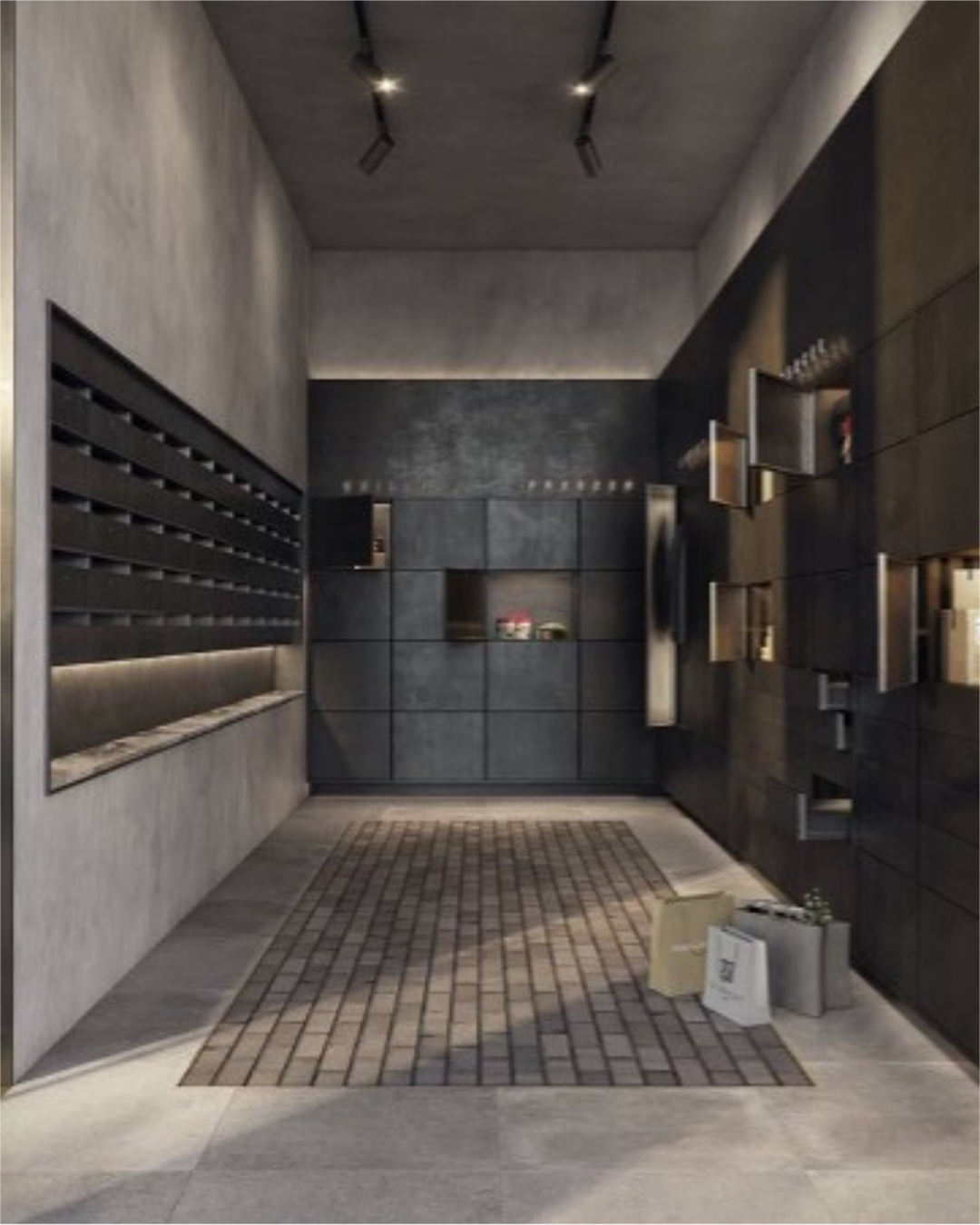
A package room is a dedicated, shared space in a building where delivered parcels are held until the recipient collects them. In most apartment and office buildings it's an open storage area — shelving, racks, or floor space near the entrance or mailroom — where couriers drop parcels off and residents or employees self-serve, searching the shelves for anything addressed to them.
The defining feature is that it's shared and open. Parcels sit on common shelving rather than in locked, individual compartments. Access is usually controlled at the room level — a door code, a fob, or a front-desk sign-in — but once someone is inside, they're browsing the same open shelves as everyone else. That openness is what makes a package room easy to set up, and also what creates most of its problems.
How a package room works
Not all package rooms are the same. The difference that matters most is whether the room is manual — relying on people to sort, log, and hand over parcels — or smart, where the space is automated with technology that handles access and tracking. The gap between the two is exactly what this article is about.
Manual package rooms
A manual package room is the traditional version. A courier is buzzed in or given a door code, walks in, and leaves parcels on open shelves. Sometimes a staff member logs each delivery by hand and messages the resident; often no one does, and residents simply check the room themselves.
It's cheap to stand up because it's really just a room with shelves. But everything about it is people-dependent, and that creates three recurring problems:
- No compartment-level security — any parcel is physically reachable by anyone else who's in the room.
- No proof of pickup — when something goes missing, there's no audit trail of who took what.
- No automatic alerts — unless a staff member logs deliveries and messages residents, no one knows a parcel has arrived until they walk down and look.
Smart or automated package rooms
A smart package room adds technology to close those gaps. Instead of open shelving and manual logging, the process changes at every step:
- Captured at drop-off — the system records each delivery as it arrives, not by hand later.
- Automatic notification — the recipient is alerted the moment their parcel is stored.
- Parcel-level access — access is tied to the individual parcel, not the whole room.
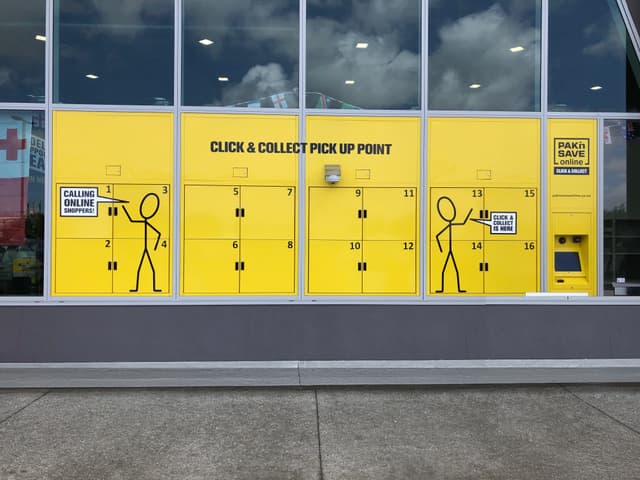
In its most complete form, the "room" is really a bank of individually secured smart locker compartments: each parcel goes into an assigned, locked compartment, and only the person with the matching code can open it. That single change — from an open shelf anyone can reach to a locked compartment released only to the right person — is what turns a liability-prone storage room into a secure, self-service pickup point.
Package room vs smart locker: what's the difference?
At a glance a package room and a bank of smart lockers do the same job: they both hold parcels until someone collects them. The difference is in how the parcel is held and handed over — and that difference decides how secure, accountable, and hands-off the whole process is.
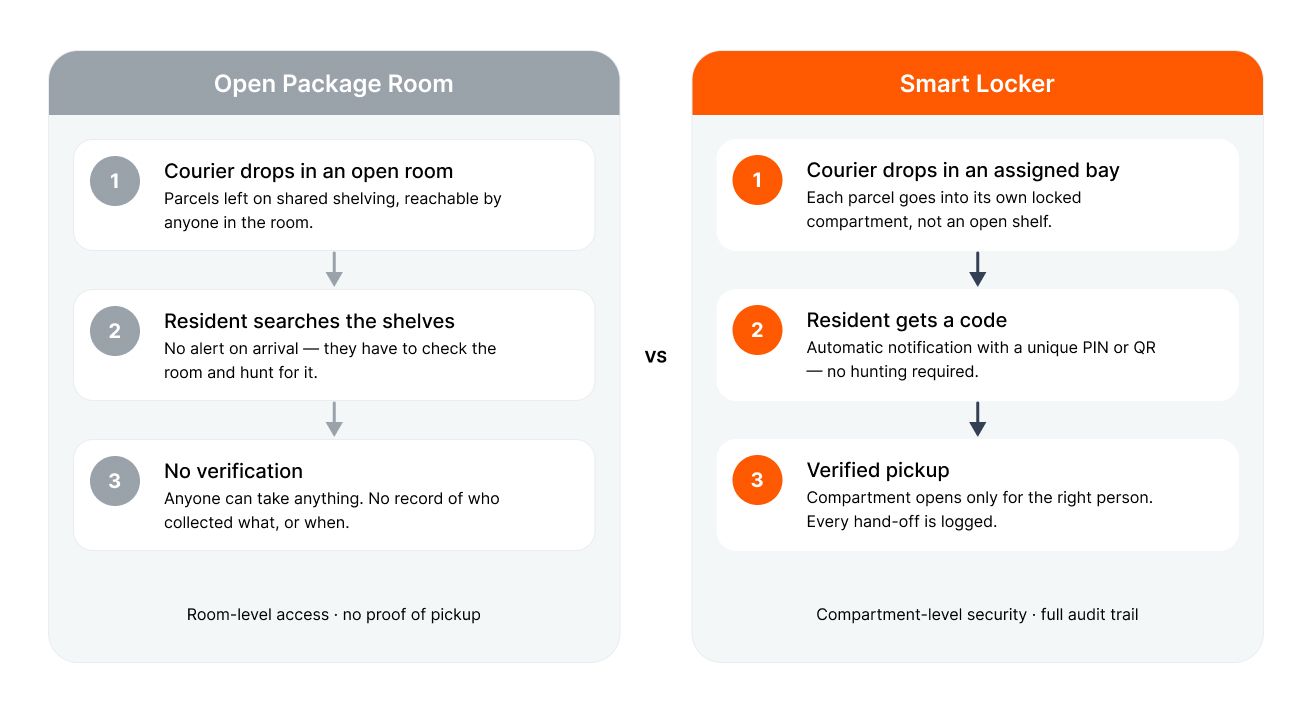
A package room stores parcels on shared, open shelving. Anyone with access to the room can see and physically reach every parcel inside it. There's typically no record tying a specific person to a specific pickup, and notifications depend on someone manually logging deliveries.
A parcel locker — the concrete, product-level version of the smart-locker category — stores each parcel in its own locked compartment. The courier drops a parcel into an assigned bay, the recipient is automatically notified, and the compartment opens only for the person holding the matching PIN or QR code. Every hand-off is verified and recorded.
| Manual package room | Smart locker / parcel locker | |
|---|---|---|
| Storage | Open, shared shelving | Individual locked compartments |
| Security | Room-level only — any parcel reachable inside | Compartment-level — released only to the right person |
| Proof of pickup | Usually none | Full audit trail of who collected what, and when |
| Notifications | Manual, if anyone logs deliveries | Automatic on drop-off |
| Staff involvement | Ongoing sorting, logging, handovers | Loads itself; staff rarely touch it |
| Setup cost | Low | Higher upfront, lower running cost |
The short version: a package room solves where do the parcels go, and a smart locker solves where do the parcels go, and how do we make sure the right person gets each one without staff in the loop. For a low-volume building the room may be enough. As volume and theft risk climb, the locker's compartment-level security and audit trail are what a package room can't offer.
Package rooms are also sometimes used as retail or BOPIS overflow on campuses and in residential retail settings.
Why apartment buildings need a package room
For multifamily buildings, a package room isn't a luxury — it's a response to a problem that's already at the front desk. Two pressures in particular drive the need.
Handling rising delivery volumes
The volume of parcels arriving at residential buildings has climbed steadily, and it spikes hard around sales events and the holidays. Without a dedicated space, deliveries pile up in the lobby, crowd the front desk, or get left in hallways. A package room gives that flood somewhere to go — but a manual room only relocates the pile-up. The parcels are off the lobby floor, yet someone still has to manage them, and the room itself can overflow at peak. Handling volume gracefully is where the automated version pulls ahead: compartments enforce order, and pickup is self-service, so a delivery surge doesn't become a staffing surge.
Reducing package theft and liability
Package theft is the reason security keeps coming up. In an open package room, a parcel on a shared shelf is reachable by anyone else who's in the room, and if it disappears there's no record of who took it. That's not just a resident's lost item — it's a liability question for the building, which is increasingly expected to keep deliveries safe. Locked, individually assigned compartments remove the exposure at its source: a parcel isn't sitting in the open, and every pickup is tied to a specific person and logged. For a fuller treatment of this specific risk, see how buildings prevent apartment package theft.
Why office buildings need a package room
Offices face a version of the same problem, with a corporate twist. Personal e-commerce orders now arrive at the office alongside business shipments, and a corporate mailroom that was built to handle a predictable flow of business post suddenly has to absorb a steady stream of employee parcels too.
In many buildings that means mailroom or facilities staff spend part of every day receiving, sorting, and redistributing packages — time that has nothing to do with their actual jobs. A package room concentrates the problem in one place; an automated package room largely removes it. Deliveries go straight into secured compartments, employees are notified and collect on their own schedule, and facilities staff stop being an ad-hoc parcel desk. For a corporate mailroom, the appeal is less about theft on a shared shelf and more about reclaiming staff time and giving employees a clean, self-service way to grab their deliveries.
Benefits of upgrading to a smart package room
Whether the building is residential or commercial, upgrading from an open room to an automated one delivers the same core wins.
24/7 resident or employee access
- Collection no longer depends on staffed hours or a manned front desk.
- Pickup is self-service and tied to a personal code, so people collect whenever they arrive — early morning, late at night, or weekends — with no one needed to hand the parcel over.
Reduced staff workload
- The system loads itself: couriers deposit parcels straight into compartments, and the software handles notifications and access.
- Front-desk and mailroom staff are freed from sorting, logging, and one-off handovers — and get that time back for higher-value work.
Better space utilisation
- An open room tends to sprawl — shelving fills up, parcels stack on the floor, and the footprint grows with volume.
- A compartmentalised system stores parcels in defined bays and turns them over faster because pickup is self-service — more storage from a smaller, tidier footprint.
Where this lands
A manual package room is the low-cost starting point and may be enough at low volume. As delivery volume and theft liability grow, the smart, compartmentalised version — individual secure compartments, PIN/QR access, automatic notifications, and a full pickup audit trail — is what closes the gaps an open room can't. The point isn't that you need somewhere to put parcels; it's that an open shelf can't tell you who took the package, and a locker can.

Streamline grocery pickups for everyone
Our smart lockers take pressure off your team and make order collection fast, contactless, and frustration-free—for every shopper, every time.
Discover solutionYour comprehensive retail locker solution
Discover fully customizable smart locker solutions that seamlessly integrate with your retail ecosystem for simplified, contactless user experiences.
Discover solution

Partnering for positive change
Click n Collect's food bank and community lockers are an effective solution for combating food insecurity and providing support to your neighbors in need.
Discover solution
Interested in our solutions?
We're here to help you find the perfect solution for your organization. Share your details, and we'll be in touch shortly.

Click n Collect provides 24/7 global support, ensuring we're always there when our clients need us.
Customer support