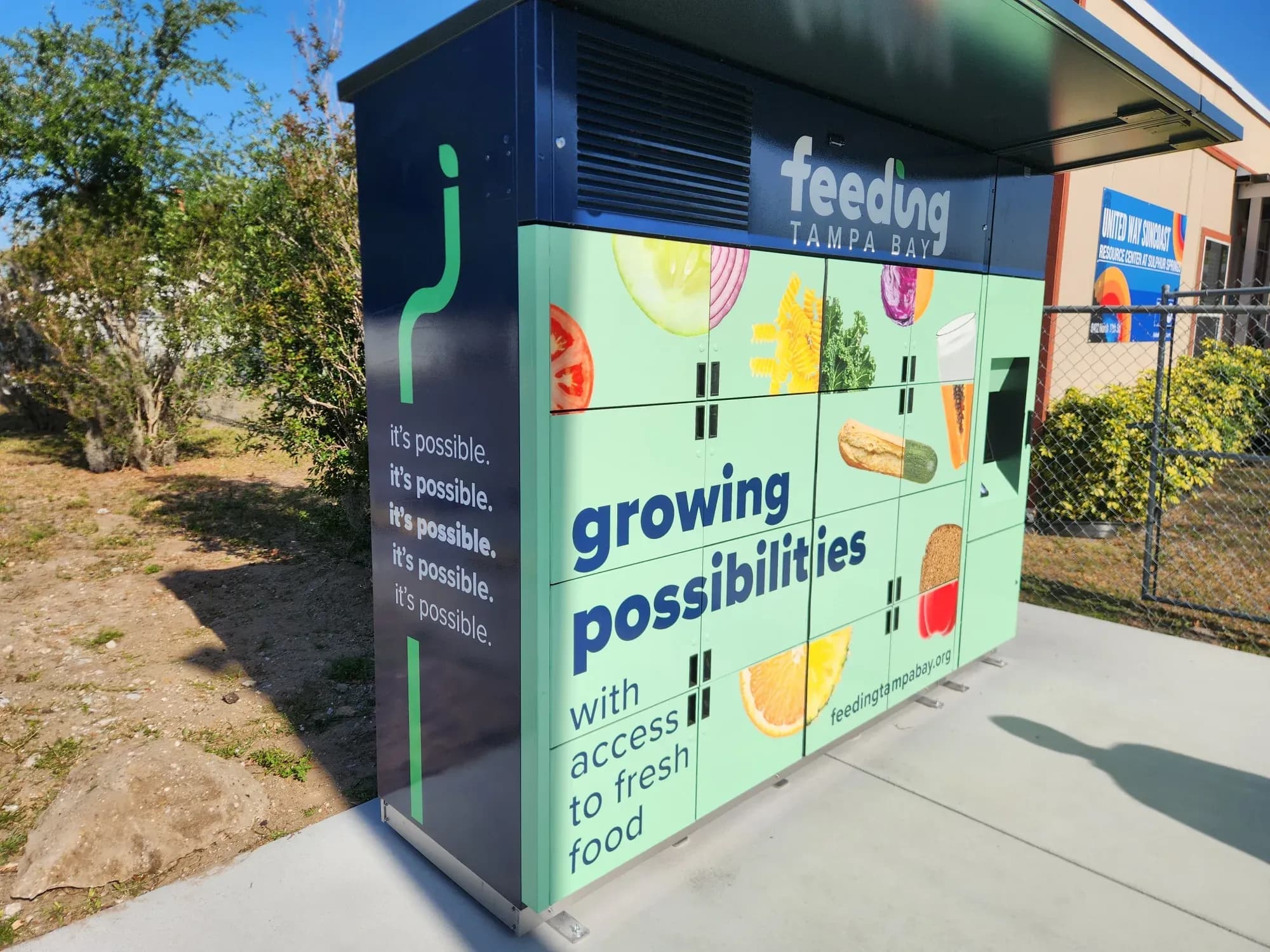
How Much Do Smart Food Lockers Cost? A Buyer's Guide
Smart food locker programs start around $65,000. What drives the cost, why quotes vary so much, and how charitable food programs have funded theirs.
How Much Do Smart Food Lockers Cost? A Buyer's Guide
Smart food locker programs start around $65,000. What drives the cost, why quotes vary so much, and how charitable food programs have funded theirs.
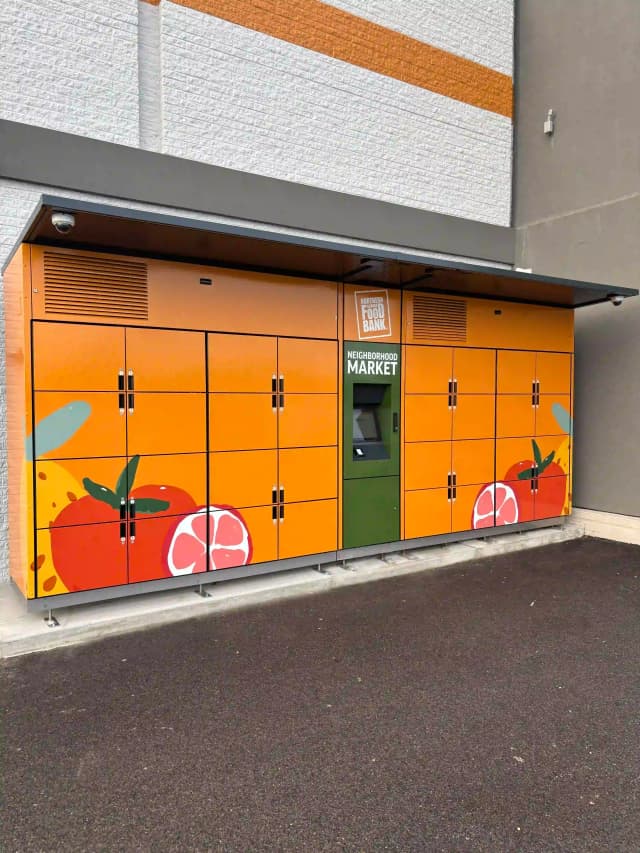
Most temperature-controlled food locker programs start around $65,000 at the time of writing. A small indoor system can land below that, but it describes roughly one project in twenty-five. The number moves more than most buyers expect, because a locker program has four cost layers and the largest variable is your site rather than the lockers. Indoor or outdoor, cabinet size, how many temperature zones, how remote the install, and what power and data already exist will all shift it. Any supplier quoting a firm price before they have discussed your site is giving you a number they cannot stand behind.
The four layers of a smart locker program
Most program leads come to this question expecting a price list. The more useful frame is a cost anatomy, because it maps onto how a funding application is structured. Two layers are one-time. Two continue for the life of the program.
- Layer one: site infrastructure. What the location needs before a locker arrives. Concrete pad or slab condition and load rating, power supply and distribution, data or cellular connectivity, lighting, drainage, weather protection, and an ADA-compliant approach with adequate clearances. For an indoor installation in an existing building with power and network nearby, this layer can be minimal. For an outdoor, standalone site, it can be the single largest component of the project.
- Layer two: the lockers and getting them running. Locker hardware configured by temperature class and size. Bank count and door mix. Vinyl wrap and branding. Freight to site. Installation and commissioning. Integration with your existing systems. Staff and volunteer training.
- Layer three: ongoing platform costs. Software licensing for the Gateway platform, connectivity, and support and maintenance. Modest relative to the capital layers, but it runs for the life of the program, and it is the layer most often left out of a funding application.
- Layer four: ongoing program costs. What it takes to run the thing once it is live. The food itself, the staff or volunteer hours to stock and manage the lockers, and the electricity to run them. This layer rarely appears in a locker quote at all, which is exactly why it belongs in your planning. A funded locker bank with no food budget and nobody rostered to fill it is a stalled program.
Who carries layers three and four varies enormously, and there is no default worth assuming. As one operator put it to us, once you have seen one food bank, you have seen one food bank. In some programs the food bank supplies the food and the host site covers electricity and labor. In others the host pantry sources its own food, or part of it. In others again a single sponsor covers the platform fee for a site indefinitely.
The point is not to predict which model you will land in. It is to name the owner of every layer explicitly, in writing, before anyone applies for anything. That conversation determines whether the program is still running in year three.
What actually moves the number
Locker hardware is relatively predictable. A given configuration costs what it costs. What varies is everything around it, and there are more variables than a web page can resolve.
- Indoor or outdoor. The largest single swing. Outdoor installations need weather sealing, a different enclosure rating, lighting, additional security consideration, and usually civil works. Indoor placement inside an existing building removes most of that scope.
- Cabinet size and how many. Compact, medium, and large cabinets serve very different volumes, and many programs run multiple banks rather than one large one. Sizing follows the number of orders waiting at any one time, not your total program volume, and most programs start smaller than they first estimate.
- How many temperature zones. A single refrigerated bank is one thing. A bank running refrigerated, frozen, and ambient compartments together is another, and mixed-zone configurations carry more refrigeration hardware and a heavier electrical load.
- Urban or rural. Freight, contractor availability, and travel time all scale with distance. A rural install in a county with one electrical contractor prices differently from a metro site.
- Power. Is there adequate supply at the location, or does a new circuit need to be run? How far from the panel? Is a trencher or core drill involved? Temperature-controlled lockers draw more than ambient parcel lockers, and that changes the electrical scope.
- Surface. Is there an existing pad rated for the load, and is it level? Pouring new concrete, or remediating an uneven surface, is a civil works line item with its own permits and lead times.
- Connectivity. Is there reliable network coverage at the exact install point? Cellular is often simplest, but coverage at a loading dock or a shaded courtyard is not always what the map suggests.
- Access and compliance. Approach path, clearances, reach ranges, and how a neighbor using a wheelchair or pushing a stroller gets to the door and back.
- Permits and approvals. Landlord consent, campus facilities sign-off, local permitting. These rarely cost much. They frequently cost time.
That is nine variables, and every one can move your number by a meaningful margin. Which is why a firm quote issued before any of them has been discussed is not really a quote. Treat a price you were given over email, from a supplier who has not asked about your site, as a placeholder.
Click n Collect builds in a wide range of sizes, temperature classes, and configurations, which is why we start with a conversation rather than a price list. The temperature-controlled product brochure sets out the range if you want to narrow your thinking first.
Why some quotes come in lower
If you are comparing suppliers, the spread between quotes is usually a specification difference rather than a pricing difference. Worth knowing what you are actually comparing.
- Indoor-only units cost less than outdoor-rated ones. If your site is indoors and will stay indoors, that is a legitimate saving. If there is any prospect of an outdoor or covered-outdoor placement, an indoor-rated cabinet will not make the transition.
- Plastic compartments cost less than steel. They also behave differently over years of daily use, particularly in a high-traffic program with heavy loads and temperature cycling. Ask what the compartments are made of and what the expected service life is.
- Ambient cabinets cost less than temperature-controlled. Obvious, but worth checking that a quote you are comparing includes the refrigeration you need, at the zones you need.
- Locking mechanisms vary widely. Doors are the part of a locker that gets used most and fails first. Ask about the mechanism, the cycle rating, and whether individual doors can be serviced.
- Software is sometimes separate. Check whether the platform, support, and updates are included, licensed separately, or assumed to be built by you.
- Serviceability differs. Ask whether a failed component can be replaced on site, and whether parts will still be available in year five. A cabinet that cannot be repaired is a cabinet that gets replaced.
None of this means the cheaper option is wrong for your site. It means you should be comparing like with like, and the way to do that is to ask every supplier the same six questions.
How programs fund this
There is no standard model, and anyone who tells you there is has seen one program.
Across programs running today, the money has come together in quite different shapes. Some secure a single grant covering the whole project, including the civil works, several years of platform fees, and in some cases food and staff time. Others assemble a mix, with a grant for the hardware, a local business sponsoring a site, and donations covering the concrete. Others again are hosted by an organization that funds its own installation and draws food from a partner food bank.
Who applies varies too. In some programs a regional food bank raises the funding and places lockers at partner sites, which means the grant relationships and the application capacity sit with the food bank rather than the host. In others the host organization applies directly. If you run a site and want lockers, it is worth asking your regional food bank before you approach a funder, because they may already have a round open and be looking for sites.
Where the money comes from
- Local voter-approved measures earmarked for community benefit. County sales tax measures that direct funding to nonprofits have paid for complete locker programs, including infrastructure and multiple years of fees. Funding raised this way is usually restricted to the jurisdiction that raised it, which matters if you serve more than one county.
- Feeding America network grants. If you are a network member or partner agency, capacity funding may be available through your food bank.
- State hunger-relief appropriations. Many states fund equipment and infrastructure for emergency food providers directly.
- Federal cold chain and capacity funding. Programs aimed at expanding refrigerated and frozen capacity across the emergency food system are a direct match, because a temperature-controlled locker adds cold chain capacity that also solves distribution. USDA has run grant programs of this type. Check what is currently open rather than relying on any single round.
- Private donors and community foundations. Local foundations often prefer tangible, visible capital projects over operating support, which works in your favor here.
- Community donations following a surge in need. When demand spikes and draws public attention, the giving that follows can be directed to infrastructure rather than absorbed entirely into immediate distribution.
- Local business sponsorship. Sponsoring a single locker bank, sometimes including its ongoing platform fee, is a smaller and more winnable ask than a grant round, and the wrap is visible and brandable.
- Health system community benefit dollars, and food-as-medicine funding. Nonprofit hospitals have community benefit obligations, and food access infrastructure in their service area is a recognized use. Where your program has a clinical referral component, state Medicaid waivers and produce prescription funding are increasingly in scope.
What to ask for, and when
However you assemble the funding, the same handful of decisions separate programs that are still running from programs that stalled. These come from operators who have been through it.
- Put the ongoing platform years into the capital ask. This is the single most useful thing on this page. Platform fees read as an operating cost, and operating costs are the hardest thing in the sector to fund, which is a well-documented pattern across nonprofit finance and not specific to lockers. Programs have solved it by treating those years as part of the capital request: paying three years of annual fees up front at the point of purchase, or writing three to five years into each grant. Do this at application, because going back for it later is a much harder conversation.
- Ask for the food in the same application where your funder allows it. Some capital grants will fund a period of program inputs alongside the infrastructure. A grant that stocks the lockers for the first year buys time to build the operating budget that sustains them.
- Do not assume the civil works are somebody else's problem. Concrete, electrical, and data connections have all been funded from the same grants that bought the lockers. Scope them and include them rather than hoping the host absorbs them.
- Name the owner of every ongoing cost before you apply. Electricity, labor, food, and the platform fee all need an owner on paper. It is far easier to agree with a prospective host at the start than after the install.
- Ask whether your funding is geographically restricted. Locally raised money frequently cannot cross a county line, which shapes where your next site can go.
- Plan for the cliff. When prepaid platform years run out, somebody picks up the fee. Decide who, and write it into the site agreement.
If you are preparing an application, our smart food locker grant proposal template is structured around these layers.
What the investment buys back
Cost is only half the case a program lead has to make. The other half is what changes once the lockers are running.
- Staff and volunteer hours return to program work. A staffed distribution window consumes people for its entire duration, whether ten neighbors come or a hundred. Locker pickup decouples staffing from access hours, which frees capacity for casework, sourcing, and outreach.
- Access extends beyond staffed hours. Neighbors working shifts, studying, caring for family, or relying on transit are frequently unable to make a weekday afternoon window. Locker access opens evenings and weekends without opening the building. Volume outside normal hours can be modest, but it represents need that previously went unserved rather than demand shifted from one time to another.
- Dignity and choice improve. Collecting an order from a locker looks the same as collecting any other order. For neighbors who avoid a visible line, that difference determines whether they participate at all.
- Perishables move further. Temperature-controlled lockers extend what a program can safely distribute, which matters when rescued and donated food skews fresh. Produce, dairy, protein, and frozen items become practical to offer through pickup.
- Reporting satisfies funders. The Gateway platform records what was allocated, collected, and when. Programs applying for renewal or expansion funding have the data already, in a form a funder recognizes.
None of these carry a universal number, because they depend on your program's size, hours, and mix. They are, however, the levers a board or a funder will ask you about, and they are worth modeling against your own baseline before you apply.
What this looks like in practice
Click n Collect is the technology partner behind charitable food locker programs across the United States.
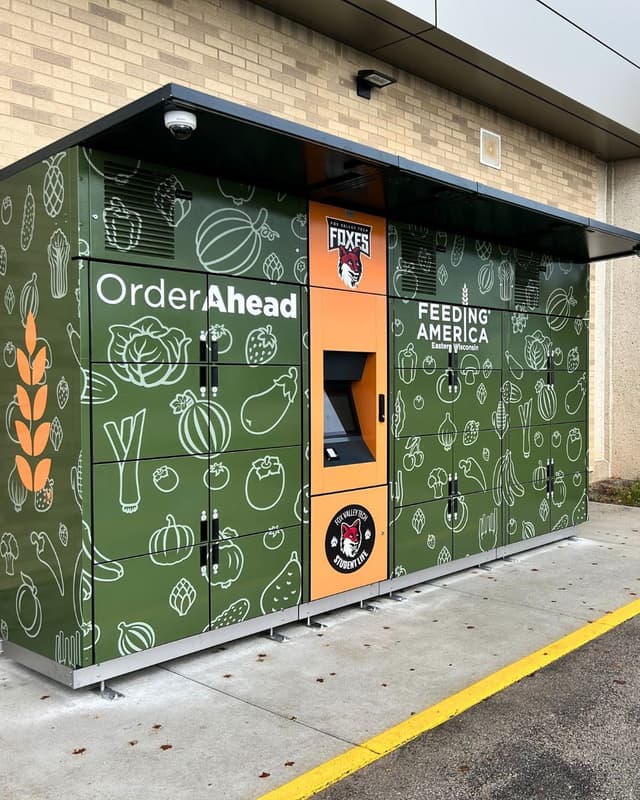
At Fox Valley Technical College in Wisconsin, the OrderAhead program runs with Feeding America Eastern Wisconsin, using temperature-controlled smart lockers to serve students on campus.
At Contra Costa College in California, the Compass Market food pantry operates refrigerated smart lockers in the campus cafeteria, in partnership with the Food Bank of Contra Costa and Solano.
NNEMAP Food Pantry in Columbus, Ohio, and HealthLinc in Indiana run programs with different models again, and both are worth reading if your context is closer to a community pantry or a clinical referral pathway.
More on campus programs in food lockers for community college campuses.
Commercial, retail, and enterprise programs
Retail, grocery, and enterprise deployments are scoped the same way, with integration depth replacing funding complexity as the main variable. Order management, POS, and last-mile system integrations are specified per client, and multi-site rollouts are costed as programs rather than as individual installations.
If that is your context, start with our retail locker buyer's guide or get in touch and we will scope it with you.
Frequently asked questions
How much does a smart locker system cost?
Most temperature-controlled food locker programs start around $65,000 at the time of writing. A small indoor system can land below that, though it describes roughly one project in twenty-five. The cost has four layers: site infrastructure, the lockers and installation, ongoing platform costs, and the ongoing cost of running the program. Site conditions drive more variation than the lockers do, so a site review is the fastest way to get a number you can budget against.
Why will nobody give me a straight price?
Because nine or so variables sit between a locker and an installed program, and a supplier who has not discussed your site cannot know any of them. Indoor or outdoor, cabinet size, how many banks, how many temperature zones, urban or rural, existing power, existing data, surface condition, and access. A firm number issued before those are answered is a placeholder.
Why are some smart locker quotes so much cheaper?
Usually a specification difference rather than a pricing difference. Indoor-only cabinets, plastic rather than steel compartments, ambient rather than temperature-controlled, lighter-duty locking, and software licensed separately or not included all reduce a quoted price. Any of those may be right for your site. Ask every supplier the same questions so you are comparing like with like.
Can grants cover the full cost of a smart locker program?
Often, yes, including the parts programs assume they will have to find elsewhere. Grants have covered lockers, concrete, electrical work, internet connections, multiple years of platform fees, and in some cases food and staff time. Others fund part of a project alongside donations or sponsorship. The determining factor is usually how the application was scoped, not what the funder was willing to pay for.
Can grant funding cover the ongoing software fees?
It can, if you write those years into the capital ask rather than treating them as an operating cost. Programs have paid three years of annual fees up front at the point of purchase, or written three to five years into each grant. Plan for who picks up the fee when those years end.
Who pays for the food and the staffing?
This is layer four, and it needs a named owner before you apply. It varies widely between programs: in some the food bank supplies the food while the host covers electricity and labor, in others the host pantry sources some or all of its own food. Some capital grants will fund an initial period of food alongside the infrastructure, which is worth asking about.
We host a site rather than run a food bank. Where do we start?
Often with your regional food bank rather than with a funder. In many programs the food bank raises the funding and places lockers at partner sites, so the grant relationships and application capacity already sit there, and some have active rounds looking for sites.
What is the cheapest way to start a smart food locker program?
An indoor installation at a site that already has adequate power and network coverage, using a smaller cabinet sized to current demand. Indoor placement removes most of the civil works and weather protection scope, and capacity can be added later as demand grows.
Are refrigerated lockers more expensive than parcel lockers?
Yes. Refrigerated, frozen, and heated lockers carry refrigeration or heating systems, insulation, and higher power requirements, so both the hardware and the electrical scope are greater than for ambient parcel lockers.
How long does it take to get a smart locker program running?
It depends on site readiness and funding timelines rather than on the lockers. Programs installing indoors at a prepared site move considerably faster than those requiring new concrete, new power, or permitting.
Do we need to own the site?
No. Many programs operate on sites they lease or occupy under agreement, including campuses, clinics, and partner locations. Landlord or facilities consent is required, and it is worth securing early because it often sits on the critical path.
What size locker bank do we need?
Sized to the number of orders you expect to have waiting at any one time, not to total program volume. Most programs start smaller than they first estimate and expand once collection patterns are established.
Can we expand a system later?
Yes. Locker banks are modular, and adding capacity to an existing site is straightforward where the site infrastructure was scoped with expansion in mind. Raising this at the site review stage is worthwhile even if expansion is years away.
Talk to us about your site
Every accurate number starts with a site review. Tell us where you want to put lockers, what you are distributing, and who you are serving, and we will work through the four layers with you, including what a funder will expect to see in the application.
Get in touch, download the temperature-controlled product brochure to see the range, or work through the charitable food locker buyer's guide on your own first.
Further reading
Lockers for growth, lockers that last
We deliver smart locker solutions for every industry challenge
Whether you want to increase sales, improve customer experience, facilitate parcel pickups after hours, or reach more people in need, we’ve got you covered.

Grocery pickup without the peak-hour scramble
Chilled and frozen orders wait at the right temperature until the shopper arrives, so your team stays on the floor.
Explore grocery lockersSelf-serve pickup and returns, any hour
Customers collect with a code in seconds, before or after store hours. At Muscat Duty Free, travelers pick up orders on arrival without queuing.
Explore retail lockers
Dignified food access outside pantry hours
Neighbors collect fresh and frozen food privately, on their own schedule. Food banks, pantries, and health clinics use our lockers to reach people who can't make distribution hours.
Explore food access lockers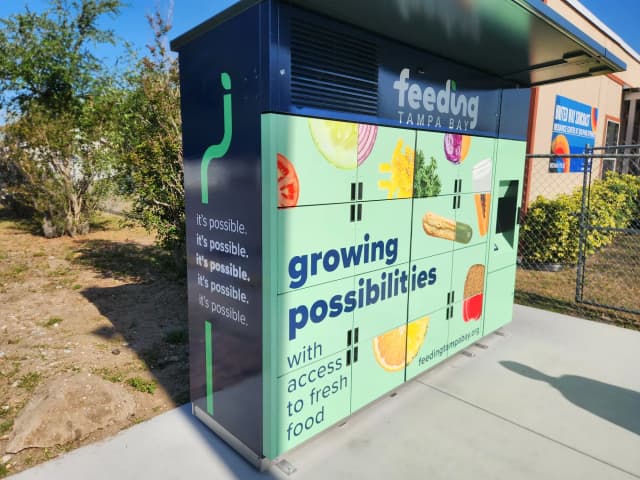
Interested in our solutions?
We're here to help you find the perfect solution for your organization. Share your details, and we'll be in touch shortly.

Click n Collect provides 24/7 global support, ensuring we're always there when our clients need us.
Customer support