Food Lockers for Community College Campuses
See how smart food lockers help community colleges close food insecurity gaps with dignified, 24/7 grocery access. Real campus case studies inside.
Food Lockers for Community College Campuses
See how smart food lockers help community colleges close food insecurity gaps with dignified, 24/7 grocery access. Real campus case studies inside.
Food Lockers for Community College Campuses
Community college students go hungry more often than students at four-year schools. They are also the hardest students for a traditional food pantry to reach. Most work. Many commute. A growing number are raising kids while they study. A pantry open nine to five, Monday through Friday, misses them by design, not by accident.
Food lockers close that gap. They give colleges a way to put groceries within reach of every student's actual schedule, not the schedule a pantry happens to keep. Below, we look at why food insecurity hits community colleges hardest, why the walk-in pantry model struggles to keep pace, and how two colleges are already using Click n Collect lockers to solve it.
Food insecurity hits community college campuses hardest
Food insecurity is not a fringe issue in higher education. It is close to the norm. The Hope Center for Student Basic Needs at Temple University surveyed 74,350 students across 91 colleges and universities for its 2025 basic needs report and found that 59% had experienced food or housing insecurity in the past year, with 41% reporting food insecurity in the past 30 days alone.
Community colleges carry the heavier share of that burden. Students at two-year institutions reported food or housing insecurity at 61%, slightly higher than their peers at four-year schools. In California, more than two-thirds of community college students who apply for financial aid report food insecurity, according to the California Student Aid Commission.
The reasons come down to who community colleges serve. These campuses enroll a higher share of working students, parents, and commuters than four-year schools do. That is a strength; it's part of what makes community college accessible. It also means the standard campus resource model, built around students who live nearby and keep a predictable schedule, does not fit as well.
The support gap compounds the problem. A 2024 GAO report found that 59% of food-insecure college students who were likely eligible for SNAP did not report receiving benefits. Eligible students are going without help they qualify for, often because they do not know it exists or cannot fit the process into an already full week.
Why the walk-in food pantry model falls short
Campus food pantries do essential work, and most colleges now have one. As of 2023, every public college and university in California operates a basic needs center and food pantry, backed by $30 million a year in state funding for community colleges alone. The infrastructure exists. The challenge is reach.
A walk-in pantry runs on fixed hours and a staffed counter. For a student who is on campus for a single evening class, works two jobs, or drives in from another town, those hours rarely line up. Commuter students, who make up the majority of community college enrollment, may only be on campus for the length of a class period. If the pantry is closed, or the line is long, the trip does not happen.
Staffing adds another constraint. Most campus basic needs offices run lean, often a coordinator and a small group of student workers or volunteers. Every hour spent staffing a pantry counter is an hour not spent connecting students to CalFresh, SNAP, housing support, or the dozens of other services a basic needs office coordinates.
Then there's dignity. A visible line at a pantry counter can be enough to keep a student away, particularly students who are older, supporting a family, or simply do not want their food insecurity to be public knowledge. None of this means the pantry model is wrong. It means it needs a way to extend beyond its own open hours and its own front counter.
How food lockers extend the campus food pantry
Smart lockers do not replace a college's food pantry or its relationship with a regional food bank. They extend both, closing the gap between when help is available and when students can get to it.
- Access that matches real student schedules. A locker bank does not close. Students can pick up an order at 6 a.m. before an early shift or at 10 p.m. after a night class, whenever the campus itself is open. For a college where most students juggle work, family, and coursework, that flexibility is often the difference between a resource students use and one they don't.
- Dignified, private pickup. There is no counter, no line, and no conversation required. A student places an order online, gets a PIN or QR code, and collects it at the locker on their own time. That privacy matters. It is one of the clearest ways a campus can offer support without asking a student to disclose their situation to anyone.
- Real groceries, not just shelf-stable items. Refrigerated and temperature-controlled lockers mean students can pick up eggs, produce, and dairy, not only canned goods. That matters for nutrition, and it matters for dignity, too: a grocery order that looks like a grocery order, not an emergency handout.
- Less pressure on already-stretched staff. Students place orders online in advance. Staff or student workers fulfill and load the lockers on their own schedule, rather than staffing a counter during posted hours. Built-in inventory visibility also helps a small basic needs team track what's moving and restock before a locker runs empty, without adding headcount.
Two community college programs running on Click n Collect
Click n Collect supplies the smart locker technology behind both of the programs below, working alongside each college's food bank partner to get it in place.
Fox Valley Technical College and Feeding America Eastern Wisconsin
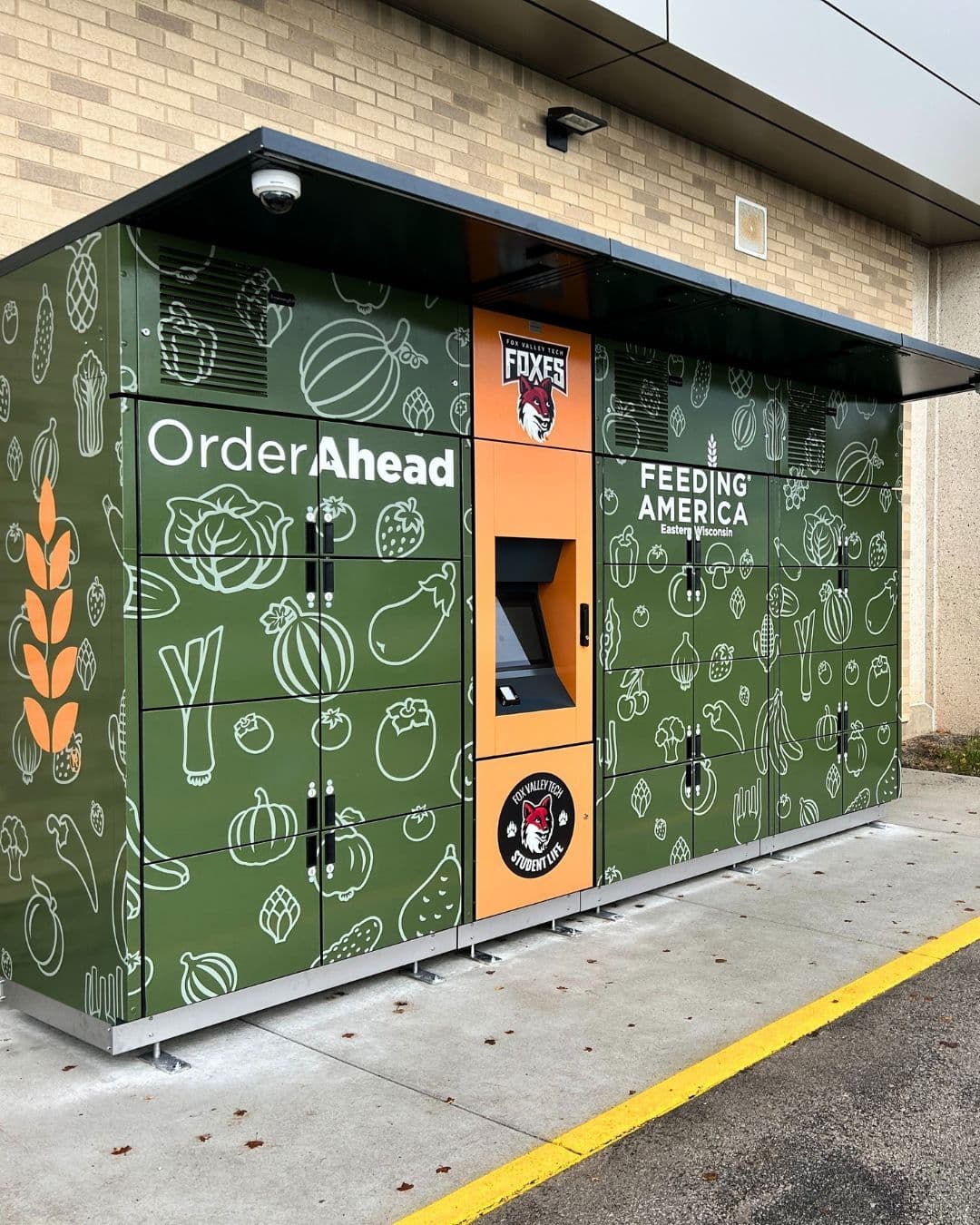
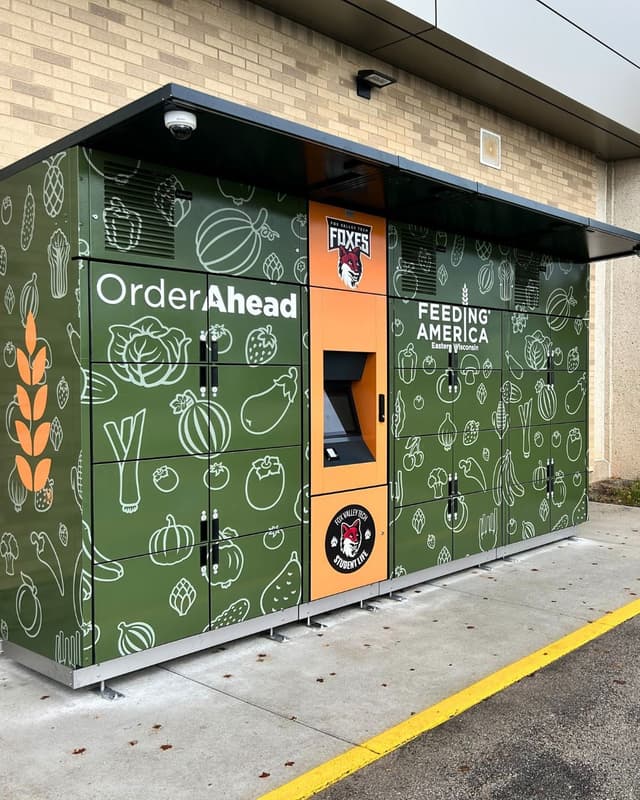
Fox Valley Technical College launched its OrderAhead program in January 2025, pairing Feeding America Eastern Wisconsin's food sourcing with Click n Collect's temperature-controlled smart lockers. Students order groceries online and pick them up from lockers placed in a discreet, low-traffic area of campus, available around the clock.
The college's existing walk-in pantry, Sly's Goods, already serves about 78 students a week. The lockers give roughly 50 more students a private, flexible way to get food that fits around work and class, without adding a second staffed counter. Feeding America Eastern Wisconsin, which supports more than 500,000 people across its 35-county service area, plans to extend the model beyond FVTC into community centers and food deserts across the region.
Contra Costa College and the Food Bank of Contra Costa and Solano
At Contra Costa College, Compass Market, the food pantry housed within the college's Compass Center, added 20 of Click n Collect's refrigerated smart lockers, installed in partnership with the Food Bank of Contra Costa and Solano. Placed in the campus cafeteria and open 7 a.m. to 7 p.m. on weekdays, students preorder groceries online and student staff fulfill and load each order.
The need is significant: more than 1,000 students used Compass Center's basic needs resources in spring 2025 alone, and nearly one in five students at the college say they expect to face homelessness within the next 12 months. "Meeting someone's basic needs makes the biggest difference," says Hope Dixon, the college's basic needs coordinator. "It allows them to focus." Dixon's goal is a one-stop hub where students connect to the resources they need in a stigma-free way, with the lockers as one part of that experience.
What a strong campus locker program needs
A handful of decisions separate a locker program that gets used from one that sits half-empty.
- A food bank or CBO partner. Every program we've deployed runs on a partnership with a regional food bank. That relationship supplies the food, and often the expertise, that a campus basic needs office does not have in-house.
- A visible but discreet location. Both colleges placed their lockers somewhere students already pass, a cafeteria or student center, rather than tucking them out of the way entirely. Visible enough to know it's there. Discreet enough that using it doesn't announce anything.
- Refrigeration from day one. Shelf-stable snacks are a start, not the goal. A refrigerated or temperature-controlled locker means students can pick up the same groceries they'd get from any store.
- Technology that doesn't need an IT project. Online ordering, PIN or QR pickup, and inventory visibility should work out of the box, with no custom software build or API integration required. That matters most for campuses with lean basic needs teams and no dedicated developer on staff.
- A funding plan. Community colleges have more paths to funding this than most people realize: state basic needs allocations, Hunger Free Campus programs, and grants through a regional food bank partner all help cover setup and ongoing cost.
Bringing food lockers to your campus
Every program on this list started the same way: a college and a food bank partner deciding the current model wasn't reaching enough students, and building something better together. We supplied the lockers behind both programs above, working alongside that partnership at every stage, from site planning through installation and ongoing support, with software that's ready to go from day one and a full API suite available for campuses that want deeper integration later.
If your campus basic needs team is ready to extend its pantry hours without extending its staff, talk to our team about a refrigerated locker program built for how your students live and study.

Grocery pickup without the peak-hour scramble
Chilled and frozen orders wait at the right temperature until the shopper arrives, so your team stays on the floor.
Explore grocery lockersSelf-serve pickup and returns, any hour
Customers collect with a code in seconds, before or after store hours. At Muscat Duty Free, travelers pick up orders on arrival without queuing.
Explore retail lockers

Dignified food access outside pantry hours
Neighbors collect fresh and frozen food privately, on their own schedule. Food banks, pantries, and health clinics use our lockers to reach people who can't make distribution hours.
Explore food access lockers
Interested in our solutions?
We're here to help you find the perfect solution for your organization. Share your details, and we'll be in touch shortly.

Click n Collect provides 24/7 global support, ensuring we're always there when our clients need us.
Customer support